Global Armor Materials Market Size, Share, Growth Report, Trends and Forecast 2034

Market Overview
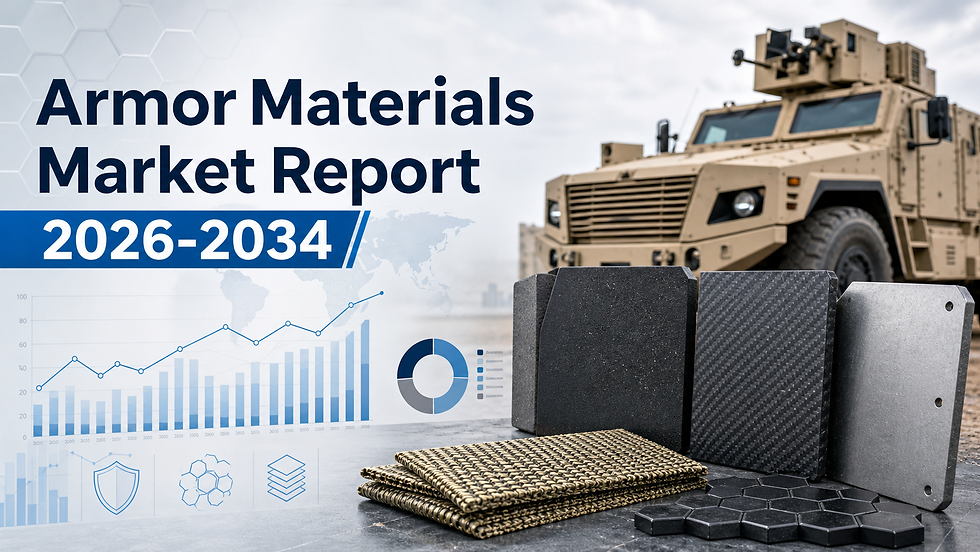
According to IMARC Group's latest research publication, "Armor Materials Market: Global Industry Trends, Share, Size, Growth, Opportunity and Forecast", the global armor materials market size reached USD 14.0 Billion in 2025. Looking forward, IMARC Group expects the market to reach USD 21.2 Billion by 2034, exhibiting a growth rate (CAGR) of 4.59% during 2026-2034, with Asia Pacific registering particularly strong growth driven by defense modernization, rising homeland security budgets, and local research and development investment into lightweight composites. Ceramic and composite products continue outpacing metal and polymer alternatives in growth terms, reflecting the industry's structural shift toward lighter, higher-performing protective materials, with body armor and vehicle armor applications commanding significant market share.
Armor materials encompass metals and alloys, ceramic and composite systems, para-aramid fiber, ultra-high-molecular-weight polyethylene, fiberglass, and other advanced protective materials used across body armor, vehicle armor, aerospace armor, civil armor, and marine armor applications spanning NIJ Level IIA through Level IV protection standards. Layered composite hybrid armors combining ceramic, metal, and laminate configurations continue delivering better ballistic resistance while significantly reducing weight and thickness compared to homogeneous armor steel, with recent research confirming that ceramic-Kevlar laminates and boron-based composites offer exceptional multi-hit resistance suited to next-generation armored vehicle platforms.
Grab a sample copy of this report: https://www.imarcgroup.com/armor-materials-market/requestsample
How AI Is Reshaping the Future of the Global Armor Materials Market
Defense contractors are increasingly applying advanced additive manufacturing, three-dimensional printing, and embedded sensor integration techniques to create lightweight, thermally resilient ceramic structures for aircraft, missiles, and space platforms.
Materials research teams are using computational modeling to accelerate development of ultra-low-temperature sintered ceramic armor formulations that maintain high compressive strength while significantly reducing production thermal budgets.
Sensor-embedded composite armor systems are increasingly incorporated into land-based defense platforms, enabling real-time structural health monitoring that supports predictive maintenance for armored vehicle fleets.
Research institutions are industrializing ceramic matrix composite technologies originally developed for nuclear energy applications, adapting them for high-temperature defense uses through advanced processing techniques.
Digital design and simulation tools are increasingly used to optimize ceramic-metal laminate configurations, balancing weight reduction against multi-hit ballistic resistance requirements for next-generation armored vehicle programs.
Key Trends in the Global Armor Materials Market
Lightweight Ceramic and Composite Material Adoption: Ceramic and composite armor products continue expanding at a faster pace than metal and polymer alternatives, driven by their superior ability to reduce weight and thickness while maintaining or improving ballistic resistance compared to traditional homogeneous armor steel.
Next-Generation UHMWPE Sheet Innovation: Manufacturers continue introducing advanced ultra-high-molecular-weight polyethylene sheet technologies, enabling substantial weight reductions in hard armor inserts, helmets, and vehicle appliqué panels without compromising protective performance.
Ceramic Matrix Composite Industrialization for Defense: Ceramic matrix composite technologies originally developed for nuclear energy applications are increasingly being industrialized for extreme-temperature defense applications, reflecting growing cross-sector technology transfer within the advanced materials ecosystem.
Soldier Survivability System Integration: Leading defense contractors continue merging ballistic protection with communication, respiratory, and ergonomic features into integrated combat systems, positioning combined solutions as preferred offerings across NATO and allied forces procurement programs.
Government Research Program Investment in Advanced Ceramics: Government research laboratories continue funding multi-year contracts targeting next-generation ceramic and ceramic matrix composite development, aimed at fielding advanced capabilities faster while reducing lifecycle costs for aerospace and defense applications.
Growth Factors in the Global Armor Materials Market
Defense Modernization and Rising Security Budgets: Sustained defense modernization programs and rising homeland security budgets across major economies continue driving substantial procurement of advanced body armor, vehicle armor, and aerospace armor materials.
Lightweight Material Demand for Soldier Mobility: Growing emphasis on soldier mobility and operational effectiveness continues accelerating adoption of lightweight ceramic and composite armor systems that maintain high ballistic protection levels while reducing overall carried weight.
Critical Infrastructure Protection Investment: Composite materials are increasingly utilized to protect critical infrastructure, including military installations, border control facilities, and transportation hubs, from ballistic impacts, blasts, and forced entry attempts, expanding the addressable market beyond traditional personnel and vehicle protection.
Advanced Manufacturing Technology Integration: Growing adoption of additive manufacturing, three-dimensional printing, and embedded sensor technologies continues enabling production of lighter, more durable armor components across defense and space applications.
Asia-Pacific Regional Defense Investment: Asia Pacific's rapid defense modernization, combined with growing homeland security spending and expanding local research and development capabilities in lightweight composites, continues positioning the region as a particularly strong growth market for armor materials.
Leading Companies Operating in the Global Armor Materials Industry
DuPont de Nemours, Inc.
Honeywell International Inc.
3M Company
BAE Systems plc
Saint-Gobain S.A.
CeramTec GmbH
CoorsTek Inc.
Morgan Advanced Materials plc
Point Blank Enterprises, LLC
Avon Protection plc
Armor Materials Market Report Segmentation
Breakup by Product Type:
Metal and Alloy
Ceramic and Composite
Para-Aramid Fiber
Ultra-High-Molecular-Weight Polyethylene
Fiberglass
Others
Ceramic and composite products continue expanding at a faster pace than other material categories, driven by their superior weight-to-protection ratio and growing adoption across layered hybrid armor configurations combining ceramic, metal, and laminate elements.
Breakup by Application:
Body Armor
Vehicle Armor
Aerospace Armor
Civil Armor
Marine Armor
Body armor and vehicle armor applications command significant market share, supported by sustained defense procurement programs and growing demand for modular, mobility-enhancing protective systems across military and law enforcement customers.
Breakup by Protection Level:
Level IIA
Level IIIA
Level III
Level IV
Products spanning the full protection level spectrum continue seeing demand, with manufacturers increasingly offering portfolios covering NIJ Level IIA through Level IV to serve thousands of defense and law enforcement agencies with varying threat protection requirements.
Breakup by End User:
Defense
Homeland Security and Law Enforcement
Civil and Commercial
Defense end users continue commanding the largest market share, supported by sustained modernization programs and next-generation head protection, body armor, and combat system procurement contracts across NATO and allied forces.
Breakup by Region:
North America (United States, Canada)
Asia Pacific (China, Japan, India, South Korea, Australia, Indonesia, Others)
Europe (Germany, France, United Kingdom, Italy, Spain, Others)
South and Central America
Middle East and Africa
North America continues commanding significant market share, anchored by sustained U.S. Army and federal procurement channels, while Asia Pacific stands out as a particularly strong growth region, driven by defense modernization, rising homeland security budgets, and expanding local research and development into lightweight composite technologies.
Recent News and Developments in the Global Armor Materials Market
January 2025: DSM firmenich, through its Avient subsidiary, introduced Dyneema HB330 and HB332, third-generation ultra-high-molecular-weight polyethylene sheets enabling weight reductions of up to 45 percent in hard armor inserts, helmets, and vehicle appliqué panels.
January 2025: CPS Technologies won a Phase I Small Business Innovation Research contract from the U.S. Army to design ultra-low-temperature sintered ceramic armor that maintains high compressive strength while significantly trimming thermal budgets during production.
February 2026: Defense agencies accelerated procurement of advanced ceramic armor systems featuring lightweight composites, aimed at enhancing soldier mobility while maintaining high ballistic protection levels across military and law enforcement applications.
June 2026: AeroVironment was awarded a USD 20 million Ceramics Advanced Materials and Processes contract by the Air Force Research Laboratory's Materials and Manufacturing Directorate, funding a 39-month effort to develop next-generation ceramic and ceramic matrix composite materials for extreme aerospace and defense applications, using additive manufacturing and embedded sensor technologies to create lighter, more durable components.
Note: If you require specific details, data, or insights that are not currently included in the scope of this report, we are happy to accommodate your request. As part of our customization service, we will gather and provide the additional information you need, tailored to your specific requirements. Please let us know your exact needs, and we will ensure the report is updated accordingly to meet your expectations.
About Us
IMARC Group is a global management consulting firm that helps the world's most ambitious changemakers create a lasting impact. The company provides a comprehensive suite of market entry and expansion services. IMARC offerings include thorough market assessment, feasibility studies, company incorporation assistance, factory setup support, regulatory approvals and licensing navigation, branding, marketing and sales strategies, competitive landscape and benchmarking analyses, pricing and cost research, and procurement research.
Contact Us
IMARC Group
134 N 4th St. Brooklyn, NY 11249, USA
Email: sales@imarcgroup.com
Tel No: (D) +91 120 433 0800
United States: +1-201-971-6302


Comments